
A wooden warship, sunk for 333 years, raised in one piece with 98% of its original timber intact. A cruise ship the length of three football pitches, capsized on its side, rotated back upright by cables thick enough to tow an aircraft carrier. And the most famous wreck in the world, sitting on the seafloor for over a century, that nobody has ever seriously proposed raising at all. Three very different stories — and all three come down to the same handful of physics ideas, applied at a scale most people never see them working at.
This article walks through how shipwreck recovery actually works — three real methods, three real ships, the formulas behind each one, and honestly, why some wrecks are better left exactly where they are.
GCSE coreThe physics everything else builds on
Two ideas do almost all the work in this article. The first is Archimedes' principle: any object immersed in a fluid experiences an upward buoyant force equal to the weight of the fluid it displaces.
Buoyant force = density of water × volume displaced × g
A ship floats when that buoyant force equals its weight. A ship sinks when its weight wins — usually because water has flooded in and replaced the air that used to keep its average density lower than seawater's. Every recovery method in this article is, at its core, a way of tipping that balance back the other way: either by adding buoyancy (air) or by removing weight (water) until the upward force wins again.
The second idea is hydrostatic pressure — the deeper you go, the harder the water pushes back:
Pressure = atmospheric pressure + (density of water × g × depth)
Worked example: seawater has a density of about 1,025 kg/m³. At just 32 metres down, the extra pressure from the water alone is roughly 1,025 × 9.81 × 32 ≈ 322,000 pascals — about 3.2 atmospheres on top of the 1 you already feel at the surface. That number matters more than it sounds, because it determines what equipment and divers can actually survive down there, and it's the real reason the three ships in this article needed three completely different approaches.
Exam-style question
Calculate the pressure due to the water alone at a depth of 50 m in seawater (density 1,025 kg/m³, g = 9.81 m/s²), and express this as a multiple of atmospheric pressure (101,325 Pa). [3 marks]
Show model answer and mark breakdown
- Pressure due to water = density × g × depth = 1,025 × 9.81 × 50 (1 mark)
- = 502,763 Pa (to the nearest Pa) (1 mark)
- As a multiple of atmospheric pressure: 502,763 ÷ 101,325 ≈ 4.96 — so the water alone adds nearly 5 extra atmospheres at this depth (1 mark)
Examiner focus: the question asks for pressure 'due to the water alone' — don't add the 101,325 Pa of atmospheric pressure unless asked for the total.
Common mistake: leaving out g from the calculation (multiplying only density by depth), which gives an answer about 10 times too small.
Method 1: Buoyancy lift — the Vasa, 1961
The Swedish warship Vasa sank in Stockholm harbour in 1628, less than a mile into her maiden voyage, top-heavy and capsized by a gust of wind. She sat at just 32 metres depth for over three centuries before being rediscovered in 1956.
The whole method in one force balance: a sunken hull's weight beats the water's buoyant force, so it stays down. Attach enough air-filled lift bags and the buoyant force wins instead — the same inequality, flipped.
The salvage team's solution followed Archimedes' principle directly: divers tunnelled cables underneath the hull and connected them to large pontoons floating on the surface. Pumping water out of the pontoons made them more buoyant, which pulled the Vasa upward a little at a time — raised in careful stages over eighteen months rather than one dramatic lift, specifically so the fragile, waterlogged hull was never subjected to a sudden shock of force.
What made this recovery remarkable wasn't just the lifting — it was what divers found underneath. The Baltic Sea is cold, low in oxygen, and too low in salinity for Teredo navalis, the shipworm that normally reduces sunken wood to nothing within years. Those three conditions together are almost uniquely protective, and roughly 98% of the Vasa's original timber survived intact. The physics of getting her up turned out to be the easier half of the story — keeping the wood from cracking and shrinking as it finally dried out took a further seventeen years of continuously spraying it with polyethylene glycol, a wax-like compound that slowly replaced the water inside each wood cell.
Method 2: Parbuckling — the Costa Concordia, 2012–2014
The cruise ship Costa Concordia ran aground off Giglio Island, Italy, in January 2012, tearing open her hull and capsizing onto her side in shallow water — close to shore, but far too large and too damaged for anything like the Vasa's gradual pontoon lift.
Parbuckling: cables pull from the far side while the hull's resting point on an underwater platform acts as the pivot — a turning force, exactly like a lever, just applied to a 114,500-tonne ship.
Engineers built an artificial underwater platform beside the wreck, then welded eleven enormous steel tanks — called sponsons — to the side of the hull that was already above water. Massive cables and hydraulic strand jacks then pulled from anchor points on the far side, applying a steady turning force that used the ship's own resting point on the platform as a pivot — precisely the same lever principle as a turning force (moment = force × distance from the pivot) taught in GCSE physics, scaled up to something the size of a building. The rotation, completed in September 2013, took about nineteen hours to bring the ship fully upright.
With the hull vertical again, a second set of sponsons was welded to the other side, and — back to Archimedes' principle one more time — all twenty-two tanks were pumped free of water and refilled with air, adding enough buoyant force to refloat the entire wreck in July 2014. She was towed to Genoa for scrapping shortly after. The whole operation cost more than $1.5 billion, making it one of the most expensive maritime salvage projects ever carried out — a reminder that the physics can be straightforward while the engineering absolutely isn't.
Method 3: Heavy-lift vessels — a more direct approach
Not every recovery needs staged buoyancy or a dramatic rotation. For wrecks that are smaller, shallower, or still structurally sound, purpose-built heavy-lift ships can sometimes attach cables or slings directly to the hull and lift it straight out of the water using onboard cranes and winches — essentially the same idea as a tow truck, scaled up to thousands of tonnes. This is the method most often used for modern shipping accidents where the vessel hasn't been underwater long enough for corrosion or marine growth to become the main obstacle.
The limitation is exactly what you'd expect from a direct lift: the hull itself has to be strong enough to take the strain of its own weight concentrated at a handful of attachment points, instead of being supported evenly by water pressure all over its surface the way it was before sinking. A brittle, long-submerged wreck like the Vasa would very likely have torn itself apart under this kind of point-loaded lift — exactly why the gentler, gradual buoyancy method was chosen for her instead.
Comparing the three methods
| Method | Best suited to | Pros | Cons |
|---|---|---|---|
| Buoyancy lift (pontoons/lift bags) | Fragile, waterlogged, or historically valuable hulls | Gentle, gradual, minimises stress on the structure | Slow; needs the hull roughly intact and stable already |
| Parbuckling + sponsons | Large capsized modern vessels near shore | Can right and refloat a genuinely huge, asymmetric wreck | Extremely expensive; needs shallow water and a stable seabed for the platform |
| Direct heavy-lift crane | Recently sunk, structurally sound, smaller vessels | Fast, direct, comparatively simple | Point-loading can tear apart weak or long-submerged hulls |
Why some wrecks are never raised at all
The Titanic sank in the North Atlantic in 1912 and wasn't found again until 1985 — lying at roughly 3,800 metres depth, over a hundred times deeper than the Vasa.
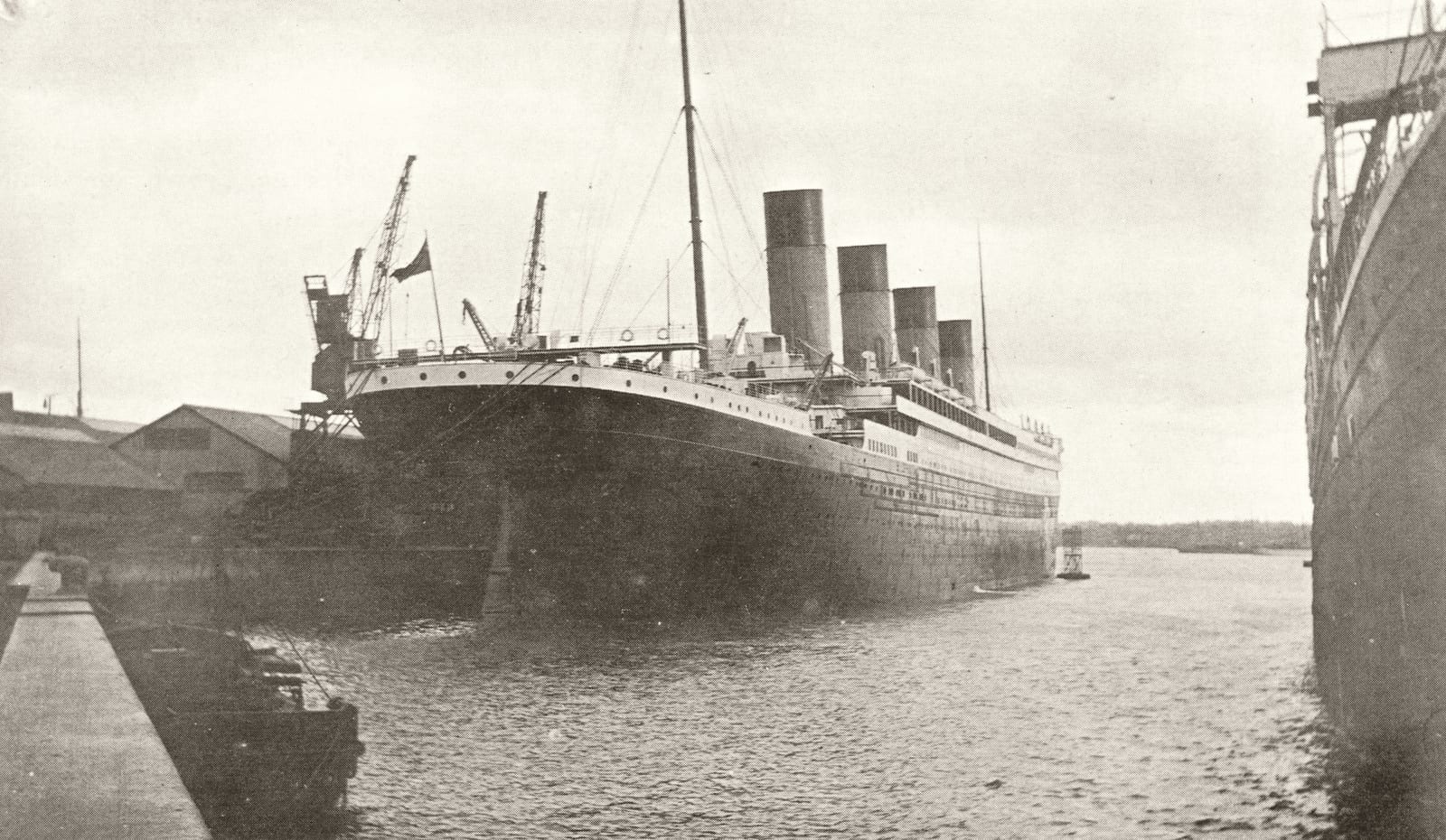
Depth is the whole story here: at 3,800 metres, the Titanic sits under roughly 380 atmospheres of pressure — more than 100 times deeper than the Vasa or the Costa Concordia, both recovered in shallow coastal water.
No serious engineering proposal has ever suggested raising the Titanic whole, and three separate problems explain why, stacking on top of each other rather than any single one being the blocker:
- Pressure. At 3,800 metres, the water pushes back with roughly 380 atmospheres of pressure — every cable, every remotely operated vehicle, every piece of lifting equipment has to be engineered for conditions vastly beyond anything used on the Vasa or the Costa Concordia.
- Structural decay. Over a century underwater has left the hull dangerously fragile — iron-oxidizing bacteria have formed "rusticles" that are actively consuming the steel, and sections have already collapsed under their own weight (including part of the crow's nest and areas of the bow). Any attempt to attach lifting cables would very plausibly tear the wreck apart rather than raise it.
- The wood is already gone. Unlike the Baltic's cold, low-salinity water that protected the Vasa, the open Atlantic has no such protection — wood-eating organisms finished off the Titanic's timber decades ago, leaving only the metal structure, and that structure is what the bacteria are now consuming too.
On top of the physics, there's a legal and ethical dimension, and it deserves more than a footnote. Over 1,500 people died when the Titanic sank, and most of them were never recovered — the wreck site is, in a very real sense, their grave. That shouldn't be something any individual, company or expedition gets to weigh against scientific curiosity or commercial interest on their own judgement. It isn't left to individual judgement: under the UNESCO 2001 Convention on the Protection of the Underwater Cultural Heritage, the wreck automatically qualified for protection the moment it passed 100 years underwater, in April 2012. A separate agreement between the UK and the US — signed in 2003, formally ratified by the US in 2019 — goes further still, requiring a joint permit from both governments before anyone may enter the hull or remove an artifact from the site at all. Even artifact recovery from the surrounding debris field remains legally contested. That two governments built a formal, binding permission system specifically so no one party could decide alone is worth genuine respect, not just a passing mention — it's the difference between a resting place staying undisturbed and being treated as fair game for whoever gets there first. Sometimes the honest, physics-backed answer to "can we get it back" is that leaving it exactly where it is turns out to be the right call, for reasons that go well beyond engineering.
A few things worth knowing
- The Vasa is now the centrepiece of its own purpose-built museum in Stockholm, still slowly monitored for wood shrinkage decades after conservation work finished — a genuinely multi-generational engineering project.
- The bacteria consuming the Titanic's hull include a species discovered specifically on the wreck and named Halomonas titanicae in its honour.
- The Costa Concordia's parbuckling rotation moved the ship by just over 65 degrees to bring her fully upright — engineers modelled the operation for months in advance, since getting the turning force wrong risked the hull breaking apart mid-rotation.
- Some researchers estimate the Titanic's steel structure could collapse entirely within a few more decades as the rusticle bacteria continue their work — meaning most of what survives today may not survive much longer, raised or not.
Try it yourself
- Using Pressure = atmospheric pressure + (density × g × depth), with seawater density ≈ 1,025 kg/m³ and g = 9.81 m/s², estimate the extra pressure (in pascals, then convert to atmospheres using 1 atm ≈ 101,325 Pa) at the Costa Concordia's resting depth of about 20 metres.
- A lift bag displaces 2 m³ of water when fully inflated. Using buoyant force = density × volume × g, calculate the buoyant force it provides in seawater (density ≈ 1,025 kg/m³). How many such bags would be needed to generate 50,000 newtons of extra lift?
- Explain, using the lever/moment idea (moment = force × distance from the pivot), why pulling a capsized ship's cables from further away from the pivot point requires less force to achieve the same turning effect — and why engineers might not always be able to choose the largest possible distance in a real harbour.
- The Titanic sits roughly 120 times deeper than the Vasa did. Using the pressure formula above, roughly how many times greater is the water pressure at the Titanic's depth compared to the Vasa's? Does that match the roughly 100× figure mentioned in the diagram?
Suggested visuals for this article
The buoyancy, parbuckling and depth-pressure diagrams above are already built into the page. A few more would make this even stronger as a standalone visual piece:
- A real photo comparison of the Vasa mid-lift in 1961 alongside the restored ship in its museum today — the contrast between "barely recognisable wreck" and "98% original timber" makes the preservation story land in a way no diagram can. **Sourcing note for whoever adds this**: use only genuinely public-domain or explicitly-licensed images — a news agency credit (e.g. a wire service) does not itself grant reuse rights, since the agency is typically licensing the photo from whoever actually captured it, not offering it freely. For the Titanic specifically, pre-sinking 1912 photographs of the ship are safely public domain by age; underwater wreck photography from any modern expedition is not, and needs a real license before use. Any real photo used here should carry a plain-language note that it's shown for historical/ educational context only.
- A time-lapse style illustration of the Costa Concordia's full rotation, showing the ship at several angles between capsized and upright, with the turning force vector redrawn at each stage — makes the moment/lever principle visually obvious as a continuous process rather than a single before/after.
- A cutaway comparison of the three wrecks drawn to the same depth scale in one image (rather than the broken-axis diagram used above), even though it makes the Titanic marker sit absurdly far down the page — the sheer awkwardness of drawing it to scale is itself the point.
If forces, pressure, moments, or any other GCSE or A-Level physics topic needs explaining through how it's actually used rather than a formula to memorise, that's exactly what our GCSE physics tutoring and A-Level physics tutoring are for — see the full learning pathway here.
Frequently asked questions
Why can't every sunken ship just be lifted with a big enough crane?
Two reasons stack up the deeper a wreck sits. First, pressure — every 10 metres of seawater adds roughly one more atmosphere of pressure, so equipment, divers and cables all have to survive conditions that get more extreme with depth. Second, and often more decisive, condition — a wreck that's spent decades or centuries underwater is usually corroded, waterlogged and structurally weaker than it looks, so the real engineering question isn't just "can we generate enough lifting force," it's "will the hull survive being lifted at all."
Why did the Vasa survive almost perfectly underwater, but the Titanic didn't?
Water chemistry, not luck. The Baltic Sea, where the Vasa sank, is cold, low in oxygen and too low in salinity for Teredo navalis (the shipworm that normally devours sunken wood) to survive — so the Vasa's oak hull stayed remarkably intact for 333 years. The Titanic sank in the open Atlantic, which has none of those protections, and its steel hull is being actively consumed by iron-oxidizing bacteria that form 'rusticles' — a completely different, much less forgiving underwater environment.
Is raising a shipwreck mostly a physics problem or an engineering problem?
Both, inseparably. Physics tells you what's possible in principle — Archimedes' principle says a big enough buoyant force will lift anything, full stop. Engineering is entirely about the practical constraints physics doesn't care about: how do you attach lift bags to a fragile, silt-covered hull without tearing it apart, how do you keep an asymmetric wreck from rolling as it rises, how do you fund a billion-dollar operation. The Costa Concordia recovery in particular was as much a story of structural engineering and project management as it was of buoyancy.
Reader ratings & reviews
Rate this article across a few different things — your rating helps other readers, and helps us improve.
Was this article helpful?
Tell us what you think — a correction, a question it left unanswered, or a topic you'd like covered next.
Prefer To Talk? Book a free video call at a time that suits you: 15 minutes for a quick question, 30 for anything else. Times show in your own time zone.

About the author
Sudershan Soni
Founder & Lead Tutor at Mostak Services — an MSc-qualified Mathematics, Science, Computer Science & STEM tutor with 20+ years of professional experience, teaching students from 11+ and GCSE to A-Level and beyond, online worldwide.
Read full profile